
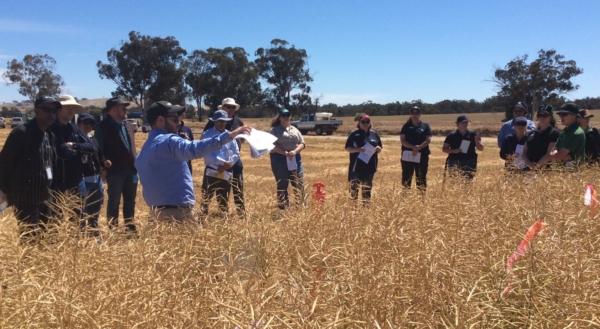
Photo credit: Government of Western Australia.
Researchers shared updates on frost tolerance, nematode resistance and oat agronomy at the Department of Primary Industries and Regional Development’s annual Dale Research Field Day near Beverley, Western Australia.
Visitors to the Dale Research Station learned about frost research and wheat and barley nematode resistance screening, both supported by co-investment from the Grains Research and Development Corp. Oat agronomy research funded by the state government’s Processed Oat Partnership also was featured.
Frost events can cost Australian grain growers hundreds of millions of dollars annually in lost production and quality, while also taking a significant emotional toll. Although widespread frost events have not occurred across Western Australia so far this year, isolated incidents were reported in the Central Wheatbelt and Great Southern regions.
Research scientist Brenton Leske said projects were addressing several frost-related challenges facing Western Australian growers. Research into reducing canola’s sensitivity to frost during pod formation and grain filling is progressing, with trials confirming differences in frost damage among varieties. Results are expected in the first half of 2027.
Researcher Amanuel Bekuma presented findings from work on chickpea chilling tolerance. Lines developed by crossing wild types with commercial cultivars were able to set flowers and produce seed under cold stress, while commercial genotypes failed to do so.
DPIRD research scientist Carla Wilkinson discussed research designed to help wheat and barley growers select varieties that limit root lesion nematode multiplication in infested paddocks. Reducing nematode populations can help improve crop growth and yields.
Garren Knell and Trent Butcher of Consult Ag joined DPIRD research scientist Blakely Paynter to discuss trials involving three new oat varieties. They also presented recommendations for nitrogen management and plant density in crops sown in early and late April.
Leske said DPIRD provides frost forecasting resources, frost maps and climate outlooks online to help growers prepare for and respond to frost events.
Frost can still occur in October, making timely crop assessments important. DPIRD’s Extreme Weather Events tool helps growers identify frost events and determine when to inspect paddocks for damage. The website also links to the Bureau of Meteorology’s MetEye tool, which provides frost forecasts up to a week in advance.
Source: Government of Western Australia, "Cool research profiled at DPIRD Dale Field Day"