
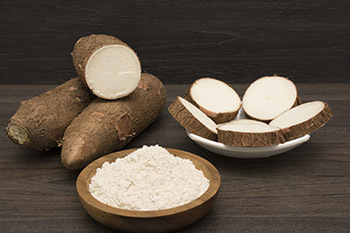
Cassava is a woody shrub that can be turned into flour by grating the roots, pressing moisture off the pulp, and drying it. Due to the scarcity of wheat flour in Africa, many nations have turned to cassava flour as a partial substitute in bread and other baked products.
Semi-Autotrophic Hydroponics (SAH) technology introduced by the International Institute of Tropical Agriculture (IITA) is increasing the production of clean cassava planting materials in Rwanda, helping strengthen the country’s cassava seed system and improve access for farmers.
Introduced in Rwanda in 2019 at the Rwanda Agriculture and Animal Resources Development Board (RAB) Rubona station, SAH has enabled the laboratory to increase its annual multiplication capacity from about 100,000 plantlets using conventional methods to as many as 300,000.
The technology provides a faster, more efficient way to multiply tissue-culture-derived cassava plantlets in a controlled environment using limited space and relatively simple materials. It also helps reduce the spread of diseases and lower seed production costs.
Access to healthy planting materials is critical for Rwanda’s developing cassava seed system. Cassava is vulnerable to viral diseases that can accumulate and spread through vegetative planting materials, making clean seed essential for maintaining crop health and productivity.
IITA has supported the adoption of SAH by training RAB technicians in laboratory operation and management, helping build national expertise in clean cassava seed production. The technology is part of a broader effort to strengthen Rwanda’s cassava seed system through improved plant health, disease-resistant varieties and expanded seed multiplication and distribution.
From the SAH laboratory and screenhouse, planting materials move through a network of seed multipliers who grow them under inspected field conditions to produce larger quantities of clean cassava seed closer to farmers.
Through the ViRCA Deployment project, 52 cassava seed entrepreneurs across Rwanda have received training and support to multiply clean cassava seed and distribute it to farmers while maintaining quality.
One of those entrepreneurs, Mukamusoni Alexia of Ruhango District, is multiplying more than 32,000 plantlets during the current agricultural season and expects to produce more than 300,000 plantlets at harvest. The materials will be distributed to other seed multipliers, who will continue the multiplication process to produce quality-declared seeds for cassava growers.
RAB is building additional SAH facilities with its partners to meet growing demand for clean cassava planting materials. Four facilities have already been built across Rwanda, with further expansion expected to increase the volume of planting materials available for multiplication and distribution nationwide.
Source: International Institute of Tropical Agriculture, "How SAH tripled cassava seed multiplication in Rwanda"