
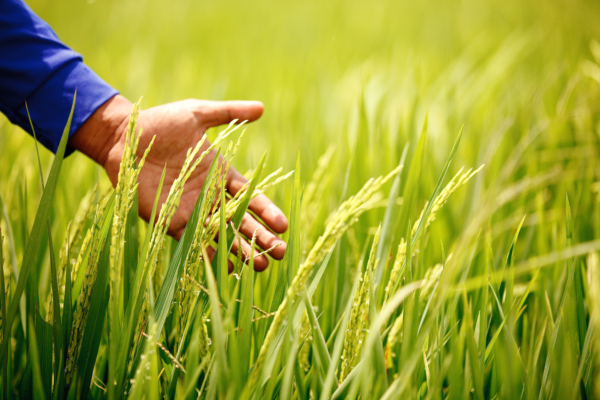
Participants in a regional learning workshop on roots and tubers visited Nam Cuong Agricultural Production, Business, and Service Cooperative in Ninh Binh, Vietnam, to examine climate-smart rice-potato production and circular farming practices.
The field exchange was part of the Asia Regional Learning Platform on Roots and Tubers, established through the CGIAR Capacity Sharing Accelerator to strengthen institutional capacity, mutual learning and long-term collaboration among national research organizations.
The regional exchange brought together 17 participants from Afghanistan, Bangladesh, Bhutan, China, India, Nepal and the Philippines for visits to Vietnam’s Central Highlands and Red River Delta.
Nam Cuong Cooperative represents approximately 1,600 farming households managing about 300 hectares, including 130 hectares of potatoes. Its production system combines mechanized direct-seeded rice with fertilizer deep placement, mechanized rice-straw composting and compost application in potato production.
The approach is designed to improve resource efficiency, soil health and farmer livelihoods.
Through partnerships involving the International Potato Center, International Rice Research Institute, CGIAR Science Program on Scaling for Impact and the USDA-funded Fertilize Right project, the cooperative has implemented a precision nutrient management model using composted rice straw as fertilizer.
The cropping cycle includes a four-month nitrogen-fixing peanut crop, a three-month rice crop that supplies straw for composting and a three-month high-value potato crop. The initiative also aims to supply safe, organic produce to feeding programs at 20 local schools, connecting agricultural production with food security and nutrition goals.
During the visit, participants learned about the cooperative's experience with seed potato imports, variety selection and community-based cold storage. They also exchanged information with local authorities, cooperative members and farmers about challenges facing rice and potato production under climate change.
An IRRI scientist explained that mechanized direct-seeded rice with fertilizer deep placement offers an alternative to mechanized transplanting. Dynamic air-assisted seeders place seeds 1 to 2 millimeters below the soil surface and fertilizer 3 to 4 centimeters deep, which can improve nutrient uptake and root health while reducing lodging.
At Nam Cuong Cooperative, the system increased rice yields 28% to 5.65 metric tons per hectare at 14% moisture content. The change also shifted production from a loss of VND 3.1 million per hectare under traditional practices to a profit of VND 13.2 million per hectare.
Participants also observed mechanized rice-straw composting. Mechanical turning combined with biochemical processes improved compost quality and reduced decomposition time from 90 days to 45 days compared with traditional methods. The process requires regular mixing, probiotic application and temperature and pH monitoring.
The cooperative plants table potatoes in late October or early November and harvests them in January for domestic markets and exports to Cambodia and Laos. A spring seed multiplication crop follows from January to March.
Seed potatoes are stored in seven cold storage facilities, each with a capacity of 40 to 70 metric tons. The cooperative reported no storage losses. It primarily imports European varieties from Germany, after previously sourcing varieties from the Netherlands. Yellow flesh, consistent tuber quality and market acceptance are among the factors used in variety selection.
Rice-potato and rice-potato-peanut rotations are important tools for managing pests and diseases. Potatoes are the cooperative's primary income source, generating net profits of about $4,750 per hectare, compared with $2,222 per hectare for peanuts. Rice is primarily grown for household consumption.
The field exchange supported South-South learning on how local innovations and institutional partnerships can strengthen resilient root and tuber production systems.
The Asia Regional Learning Platform on Roots and Tubers is scheduled to operate from August 2026 through April 2027. Its initial phase combines field-based learning, online knowledge exchanges and joint planning to help national institutions identify shared priorities and develop future capacity-sharing initiatives.
Source: CGIAR, "Regional Experts Explore Climate-Smart Rice–Potato Production in Vietnam"