
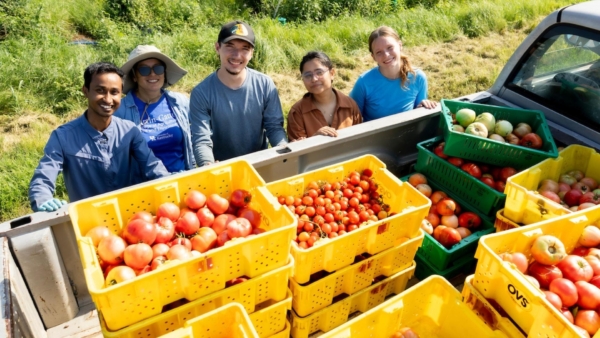
Photo credit: Sabrina Hounshell, University of Kentucky.
A University of Kentucky laboratory is using breeding and genetics research to develop fruit and vegetable varieties with improved productivity, disease resistance, flavor and nutritional quality.
The Sapkota Horticultural Breeding and Genetics Lab, located on the university’s campus and at the Horticultural Research Farm, is led by Manoj Sapkota, assistant professor in horticultural crop breeding for nutrition in the Department of Horticulture at the Martin-Gatton College of Agriculture, Food and Environment.
The lab’s mission is to enhance crop productivity, increase disease resistance and improve nutritional quality to meet the needs of growers, producers and consumers in Kentucky and beyond.
Sapkota works with research staff, undergraduate and graduate students, and volunteers on projects that include field-based tomato breeding, strawberry disease-resistance screening, seed morphology, herbicide resistance and computer vision-assisted phenotyping.
Students working in the lab represent a range of academic disciplines, including agricultural and medical biotechnology, biology, computer science, data science, health sciences, horticulture and neuroscience. Sapkota said the range of expertise helps the lab develop new breeding tools while training students for careers in plant science.
Combining Expertise Across Disciplines
One student, Caroline Potts, is majoring in human health sciences in the UK College of Health Sciences. She works with Sapkota and other student researchers to study crop improvement through nutrition, human health and consumer-focused research, including sensory testing and surveys.
The work initially is focused on tomatoes, with researchers evaluating consumer preferences and other characteristics that can contribute to improved varieties.
Searching for a Super Tomato
The lab also is working toward developing what Sapkota describes as a super tomato, combining desirable traits for consumers, growers and producers. The goal is to develop tomatoes adapted to Kentucky conditions that offer strong yields, disease resistance, flavor and nutritional quality.
At UK’s South Farm, Sapkota and his student researchers are growing more than 250 tomato varieties, breeding lines and other genetic materials as they search for combinations of traits that could contribute to improved varieties.
Tomatoes are an important model crop for genetics and genomics research, and findings from tomato studies can provide insights into related crops and the genetic basis of important plant traits. Tomatoes also are an important vegetable crop for growers in Kentucky.
Developing a tomato that meets the preferences of all consumers presents challenges because flavor preferences vary and nutritional quality involves numerous compounds and traits.
After harvest, selected tomatoes are brought to the Sapkota Lab on campus for additional measurements and analyses of quality, flavor and nutritional characteristics. Field evaluations and data analysis from the 2026 growing season will continue through the fall, with new publications from the research anticipated in 2027.
Source: University of Kentucky, "Searching for the ‘super tomato’: UK lab is advancing horticultural crop breeding for a healthier future"