
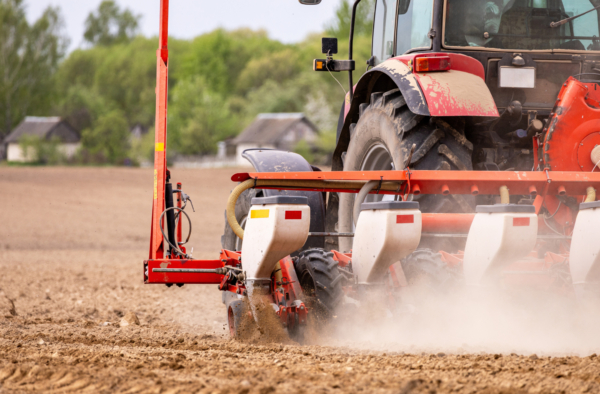
A project led by the International Rice Research Institute has significantly increased adoption of mechanized direct seeded rice production in Vietnam's Can Tho region, demonstrating how precision planting and digital extension tools can improve productivity while reducing agricultural inputs.
The Fertilize Right project, funded by the U.S. Department of Agriculture, reported that adoption of mechanized direct seeded rice increased from 0.7% of farmers in 2023 to 18% after two years in the Thanh An, Thanh Phu, Thoi Xuan and Trung Hung communes in Vietnam. Fertilizer deep placement, a complementary practice, also expanded its reach to 0.5% of farmers and continues to grow.
The production system uses dynamic, air-assisted row seeders to place seed precisely into the soil while delivering fertilizer directly to the root zone. According to field trials conducted with the Cuu Long Rice Research Institute across four cropping seasons from 2024 through 2026, the approach reduced seed use by at least 50%, lowered nitrogen fertilizer applications by at least 20% and decreased the carbon footprint per kilogram of rice produced by at least 10%. Researchers also observed more uniform crop stands and improved resistance to pests, disease and lodging.
Farm-level comparisons found that mechanized direct seeded rice fields produced average yields of 6.81 metric tons per hectare compared with 6.67 metric tons per hectare for conventional broadcast seeding, representing a 2.1% increase. Nitrogen use efficiency improved by 1.4%, while net income per hectare increased by 2.7%.
The project supported adoption through a combination of field demonstrations and digital agriculture training. Between October and December 2025, IRRI and Can Tho's Sub-Department of Plant Production and Protection trained nearly 3,000 farmers, agricultural dealers and extension personnel to use digital decision support tools, including the Rice Crop Manager app, the Lúa Việt e-extension platform and EasyFarm.
A 5.5-hectare demonstration at the Thuan Loi Agricultural Cooperative showcased the integration of mechanized direct seeded rice with fertilizer deep placement using the 4R nutrient stewardship principles of applying the right fertilizer source at the right rate, right time and right place. The demonstration reduced seeding rates to 60 kilograms per hectare and cut fertilizer applications to two per crop. The event attracted 122 participants, including farmers, agricultural businesses and government officials.
The initiative is supported through partnerships with the Cuu Long Rice Research Institute, Can Tho's Department of Agriculture and Environment, the Sub-Department of Plant Production and Protection and the National Agricultural Extension Center. In October, the partners trained 253 farmers and agricultural officers from Dong Thap, Can Tho and An Giang on the 4R principles and digital extension tools as part of Vietnam's One Million Hectares of High-Quality, Low-Emission Rice program.
The project aligns with Vietnam's effort to expand production of higher quality, lower emission rice by promoting precision agriculture and digital advisory services. Building on results in Can Tho, additional mechanized direct seeded rice demonstrations are planned in Hung Yen, Ninh Binh and Hai Phong provinces in early 2026.
The findings highlight opportunities for the seed industry as precision seeding technologies become more widely adopted. Mechanized direct seeding systems that improve seed placement accuracy while reducing seeding rates may increase demand for high quality seed with strong germination and uniform emergence, supporting broader adoption of precision crop establishment practices in rice production.
Source: CGIAR, "Adoption Soars from Less Than 1% to Nearly 20%: Mechanized Direct Seeding Takes Root in Can Tho"