
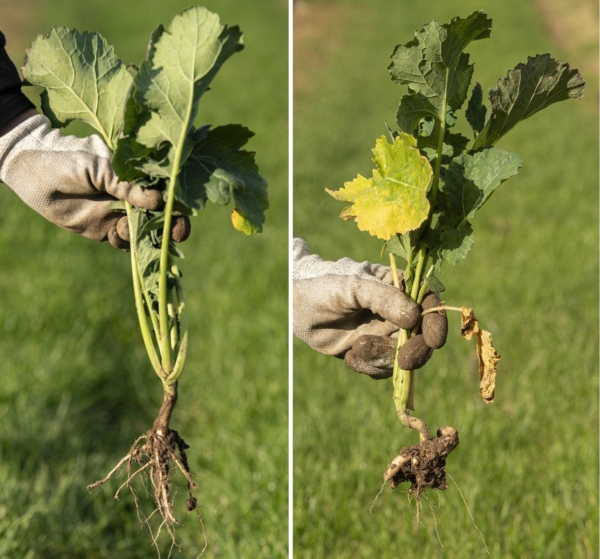
(KWS)
Einbeck, Germany (February 27, 2025) - An infestation with cabbage hernia endangers rapeseed stocks worldwide.
Depending on various environmental factors, the highest yield losses are possible. However, the resistance of previous varieties to the disease that are equipped with Mendel genetics is increasingly losing its effectiveness.
With PBR1, KWS has now identified a completely new resistance gene, decoded it and crossed it into the first varieties. The new genetics are very promising – this is also confirmed by official trial data from renowned agricultural institutes in Germany and France.
"With the new resistance gene PBR1 (Plasmodiophora brassicae Resistance), we have discovered very strong genetics that, against the background of increasing resistance breaks, represents a significant improvement over the currently available Mendel genetics," says Susann Volkmann, who is responsible for the cabbage hernia breeding program at KWS.
Since 2011, KWS has been conducting intensive research into new sources of resistance to cabbage hernia. The combination of the well-known Mendel genetics with the newly developed resistance PBR1 is a decisive step forward, as it significantly improves the range of effect of the resistance.
"The aim is to broaden the resistance to cabbage hernia and thus protect the rapeseed plants more effectively against infestation," Volkmann says.
The Federal Plant Variety Office in Germany and the French testing institute GEVES (Groupe d'Étude et de contrôle des Variétés et des Semences) have already tested the genetics in official series of experiments and confirmed their effectiveness. KWS KREATOS is the first variety to combine the new resistance gene with Mendel genetics. It is the promising start in a pipeline of variety candidates.
Cabbage hernia
Cabbage hernia (clubroot) is a disease caused by a soil-borne pathogen (Plasmodiophora brassicae). Areas where cruciferous vegetables, including rapeseed, are traditionally grown, are usually particularly affected.
On the main and lateral roots, tuberous growths (root galls) develop when infested, which means that the plant can no longer be sufficiently supplied with water and nutrients. The pathogen living in the soil can survive there for up to 20 years.
With the development of successful resistances and high-yielding varieties, KWS continues to be a driver of innovation in the industry. For example, KWS was the first company in the world to offer high-yield winter rapeseed varieties with the new resistance gene RlmS to Phoma for sowing in France in 2019/2020.
Last year, another winter oilseed rape variety was approved, which is equipped with the new source of resistance LepR1. In 2020, the renowned French agricultural research institute Terres Inovia certified that a winter rapeseed variety from KWS is much less susceptible to the larvae of the rapeseed flea beetle than comparable varieties from other breeders. In the meantime, KWS has launched other varieties with genetic protection against the oilseed rape flea in various markets under the name InsectPROTECT.
About KWS
KWS is one of the world's leading plant breeding companies. Almost 5,000 employees* in more than 70 countries generated sales of around 1.68 billion euros in the 2023/2024 financial year. For almost 170 years, KWS has been run independently and independently as a family-owned company. The focus is on plant breeding and the production and sale of sugar beet, corn, cereals, vegetables, rapeseed and sunflower seeds. KWS uses state-of-the-art plant breeding methods to increase farmers' yields and further improve the resistance of plants to diseases, pests and abiotic stress. To achieve this goal, the company invested more than EUR 300 million in research and development in the past fiscal year.
*excluding seasonal workers
Further information: www.kws.com/corp/de. Follow us on LinkedIn: LinkedIn_KWS Group